
ANSYS is a general purpose finite element modeling package for numerically solving a wide variety of mechanical problems. These problems include: static/dynamic structural analysis (both linear and non-linear), heat transfer and fluid problems, as well as acoustic and electromagnetic problems. In the past, obtaining all of the simulation capabilities needed for complex and demanding modeling scenarios frequently meant combining several different software packages. ANSYS Multiphysics provides the analysis industry's most comprehensive coupled physics tool combining structural, thermal, CFD, acoustic and electromagnetic simulation capabilities into a single software product. ANSYS Multiphysics integrates the power of direct (matrix) and sequential (load vector) coupling to combine the appropriate "physical fields" required for accurate, reliable simulation results in applications ranging from cooling systems, power generation, to biotechnology and Micro Electro Mechanical Systems (MEMS).
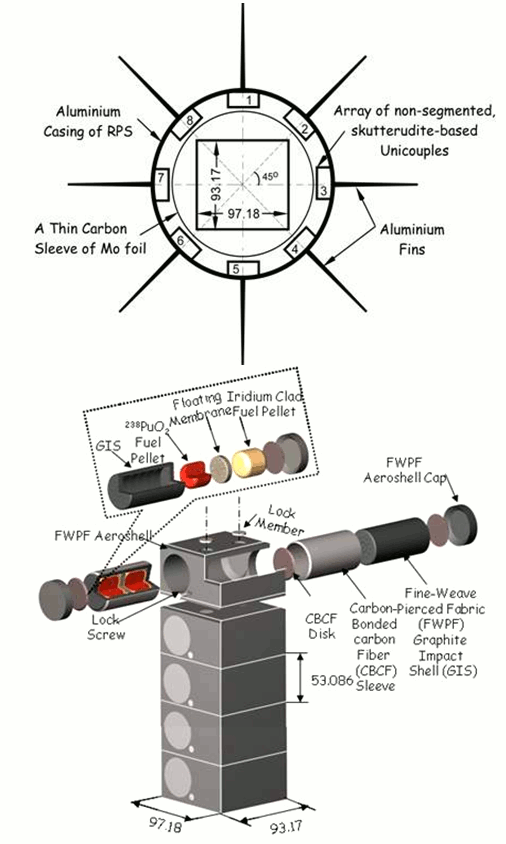
Figure 20. Skutterudite Thermoelectric Radioisotope Power System for generating 100 We for > 10 yrs in support of future NASA Planetary Exploration Missions (top); a stack of General Purpose Heat Source Modules with 238PuO2 Pellets (bottom). Each module generated a total of 250 Wth at Beginning of Life [27].
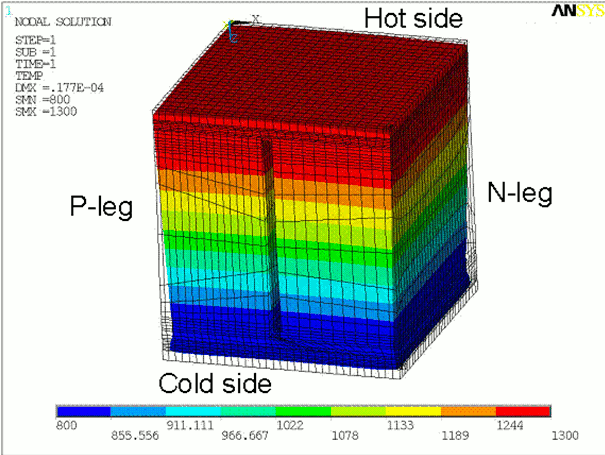
Figure 21. Temperature contours and displacements in a SiGe Thermoelectric unicouple of a Power Conversion Assembly of a Jupiter Icy Moon Orbiter Spacecraft.
The software easily simulates complex thermal-mechanical, fluid-structural and electrostatic-structural interactions, and includes the complete range of powerful ANSYS iterative, direct and eigenvalue matrix solvers. ANSYS Mechanical includes a full complement of nonlinear and linear elements, material laws ranging from metal to rubber, and the most comprehensive set of solvers available. It can handle even the most complex assemblies especially those involving nonlinear contact and is the ideal choice for determining stresses, temperatures, displacements and contact pressure distributions on all your component and assembly designs.
The UNM-ISNPS has developed and designed a novel, thermoelectric radioisotope power system for NASA's future space and planetary exploration missions (Fig. 20). This system will not only have a specific electric power greater than 12 We/kg, which is more than twice that of the state-of-the-art GPHS Radioisotope Thermoelectric Generators (which power the Voyager, Galileo and Ulysses probes), but also an overall efficiency greater than 14%. Such high conversion efficiency would halve the amount of plutonium dioxide fuel needed for a given electric power requirement. The proposed advanced power system couples novel, segmented thermoelectric unicouples, based on advanced thermoelectric materials developed at the Jet Propulsion Laboratory (JPL), to one or several standard General Purpose Heat Source bricks, and would be easily scalable to meet missions power requirement ranging from a few watts to hundreds of watts.
During the course of this work, it was necessary to create and incorporate new numerical elements and new routines in the very powerful ANSYS 5.7 finite elements software to extend the capabilities of the software for ultimately modeling the entire radioisotope power system as well as the experimental setup. ANSYS has also been used at UNM-ISNPS to perform thermo-mechanical analyses of non-segmented (Fig. 21) and segmented multicouples for RPSs.
Back to The Top