COMSOL is a commercial software package that uses the finite element scheme to numerically solve not only single physics, but also multi-physics problems in engineering applications. Multiphysics modules include fluid flow, heat transfer, structural mechanics, chemical, and others. COMSOL Multiphysics provides very convenient environment by integrating all modeling process into one package from building geometries (2D and 3D), meshing, defining user equations, to visualizing and exporting results. COMSOL Multiphysics also supports parallel computing, allowing users to effectively solve large engineering problems by distributing multiple jobs to separate nodes of a cluster computer to overcome the memory challenge associated with commercial finite element packages.
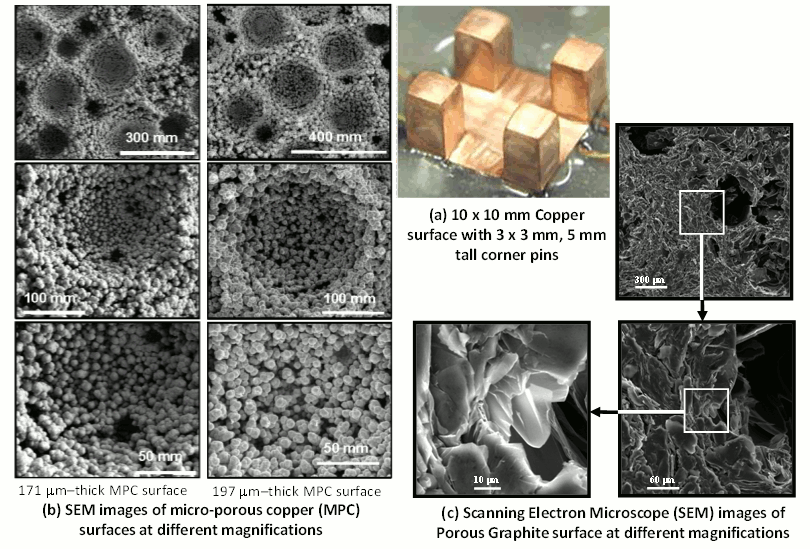
Figure 13a. Surfaces investigated for enhancing nucleate boiling of dielectric liquids (FC-72, HFE-7100 and PF-5060) for immersion cooling of high power computer chips. (Click for larger version)
Since 1990s, extensive experimental research has been performed on immersion cooling nucleate boiling of high power computer chips using dielectric liquids. Experiments investigated various surfaces measuring 10 x 10 mm in footprint. These surfaces include plane copper with various roughness and with corner pins, porous POCO graphite and micro-porous copper surfaces deposited using electrochemical deposition at a high current density. Experiments also investigated the effects of surface orientation from upward-facing (0o inclination) to downward-facing (180o inclination) on nucleate boiling heat transfer and the Critical Heat Flux (CHF). Figure 13a shows photographs of some of the surfaces investigated for enhancing nucleate boiling of the dielectric liquids PF-5060, FC-72 and HFE-7100.16-20
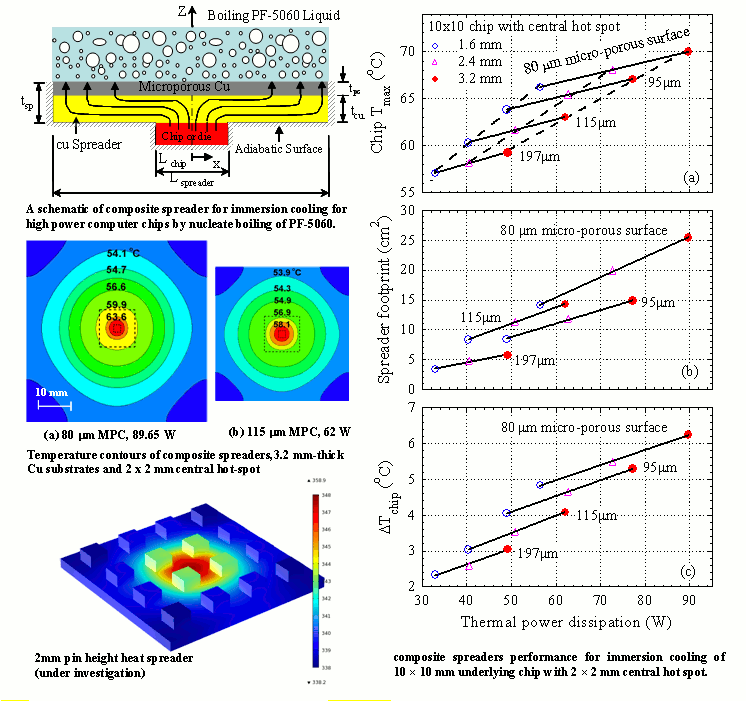
Figure 13b. Results of performed full 3-D thermal analyses of copper spreaders with micro-porous Cu or pins for cooling a 10 x 10 underlying computer chip with central hot spot, using COMSOL multi-physics code. Dissipated heat is removed from spreader surface by saturation boiling of PF-5060 dielectric liquid.21-22
In practical applications of immersion cooling of high power computer chips, heat spreaders with surfaces for enhancing nucleate boiling could be utilized to increase the removal rate of the thermal power dissipation by the underlying chip and mitigate the effect of hot spots. Numerical analyses of theses spreaders with a micro-porous copper surface and copper pins 3 x 3 in cross-section and 2- 5 mm tall have recently been performed using the COMSOL Multiphysics commercial software. Some of the results obtained are shown in Fig. 13b.21,22
A 3-D numerical thermal analysis has been carried out using COMSOL 4.0 to investigate the thermal performance of planar copper and copper spreaders with MPC surface. The MPC spreader are comprised of copper substrate and a MPC surface of 10's of microns thick for cooling a 10 x 10 mm underlying chip with central hot spot (Fig. 13b). The chip is assumed to have different hot spot areas with variable heat flux ratio. The effect of thermal interface material between the chip and the heat spreaders is also investigated. COMSOL results have been validated successfully against those obtained by ANSYS - finite elements commercial software for planar copper spreaders and copper spreaders with porous graphite surface.23,24 The total thermal power removed, the foot print area, spatial distribution of the surface temperatures of the spreaders and surface temperature distribution of the underlying chip are calculated (Fig. 13b).
An emulsion is a mixture of two immiscible liquids in which one liquid in the form of droplets is dispersed in a continuous phase of the second liquid. Emulsions are encountered in chemical; petroleum; energy; pharmaceutical; food processing and cosmetics industries and used in medical procedures; drug delivery; polymerization processing; microanalysis; extraction processes and microsystems. Emulsions of mono-disperse micro-drops have been the subject of extensive investigations by numerous investigators. The aim has been to generate mono-disperse droplets of controllable sizes, ranging from a fraction to 10's of microns, at high frequencies. Conventional methods to produce emulsions involve injecting a liquid at a constant flow rate through an orifice or a capillary tube into a continuous immiscible liquid that is quiescent or dynamically inactive. These methods are inefficient because the bulk of the dispersed liquid is not used. In addition, the production rates of disperse droplets are relatively low and the emulsions are highly poly-disperse. To overcome some or all these limitations, recent techniques of membrane extrusion, micro-thread generation and viscoelastic shear have been proposed. Although more effective, each technique has some inherent limitations. For example, the poly-dispersity in the emulsion produced using membrane emulsification is ~ 10% of the average drop size, and as much as 16% in production condition using the viscoeleatic shear technique. A good control of the size, production frequency and the dynamics of forming disperse droplets, is achieved using co-flowing immiscible liquids (Fig. 14). This method not only provides better control of the droplet volume, but also produces highly mono-disperse emulsions. The forming droplets of disperse liquid at the tip of the inner micro-tube, grow, deform and eventually detach, or pinch off in a cyclical fashion. The formation dynamics of the droplets and the effects of the various controlling parameters have been investigated using COMSOL multi-physics code.
For co-flowing immiscible liquids in co-axial micro-tubes, two mechanisms of forming disperse droplets have been observed experimentally and predicted numerically. These are: (a) dripping, in which the forming droplet detaches directly off the tip of the inner micro-tube, and (b) jetting, in which the forming droplet detaches at the end of an extended thread or filament of the disperse liquid, some distance downstream from the tip of the inner micro-tube. The highly mono-disperse emulsion produced by the first mechanism prevails at low flow rates of disperse and continuous liquids. By contrast, the forming emulsions in the jetting regime at high liquids flow rates could be highly poly-disperse. For both mechanisms, increasing the flow rate of the continuous liquid decreases the size and increases the forming frequency of the droplets. In these mechanisms, there is a great degree of control on the operating parameters for producing the droplets, owing to the large interfacial area between the two, co-flowing immiscible liquids. The formation of mono-disperse droplets in the dripping regime evolves in three successive stages: (a) steady growth; (2) deformation and necking; and (3) detaching or pinch off (Fig. 14a -14c).
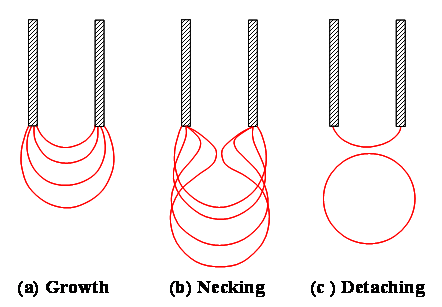
Figure 14. Growth, necking and detaching (or pinch-off) of a disperse droplet at the tip of a micro-tube in a continuous co-axial flow of an immiscible liquid.
The formation dynamics of disperse droplets in a system of two co-flowing immiscible liquids depend on many parameters, which are easily controlled in an experiment or industrial production. These are the average flow rates (or injection velocities), dynamic viscosities and densities of the continuous and disperse liquids; the diameters of the co-axial micro-tubes and the interfacial tension. Numerical simulations of the formation of disperse droplets in a system of co-flowing immiscible liquids in coaxial micro-tubes have used different numerical methods to solve the transient Navier-Stokes equations of the liquids, subject to the momentum jump condition at the interface. These simulations track the growth, surface topology, necking and the eventual pinch off of the disperse droplets.
In the dripping regime the drag force by the continuous liquid flow onto the interface with a growing disperse droplet causes necking and eventual pinch off of the droplet. In this regime, a precise control of the size and frequency of the forming droplets is possible by varying the flow rates of the co-flowing liquids. Forming either mono-disperse or poly-disperse droplets in the dripping regime depends on the flow rates and properties of the continuous and disperse liquids, the diameters of the co-axial micro-tubes, and the interfacial surface tension.
Numerical simulations are being carried out at the Institute for Space and Nuclear Power Studies, university of New Mexico, to investigate the dynamics and controlling parameters of forming micro-droplets of a disperse liquid in a continuous immiscible liquid, co-flowing in a co-axial micro-tube (Fig. 15). These simulations investigate the contributions of various parameters affecting the formation dynamics and frequency and the radius of disperse droplets. The simulations solve the transient, 2-D axisymmetric Navier-Stokes equations in the computational domains of the co-flowing liquids and the advection equation of the interface between the two immiscible liquids, subject to the prevailing momentum jump condition at the interface. The numerical solution of these equations uses a finite element method based on the capabilities of the COMSOL Multiphysics, version 4.0.
The numerical simulations track: (a) the disperse droplet transient growth and eventual pinch off; (b) the evolving interface between the co-flowing liquids during the initial formation and growth of the disperse droplet, and (c) the induced liquid circulation inside the droplet at different stages of growth to an eventual pinch off. The obtained numerical results of the effects of different controlling parameters are used to develop empirical correlations for the dimensional radius and the formation frequency of the disperse droplets in terms of the capillary number of the continuous liquid and the ratios of Reynolds numbers and diameters of micro-tubes of the co-flowing immiscible liquids.
Figure 15 depicts the formation of a disperse droplet of an incompressible and Newtonian liquid at the tip of a micro-tube with an inner radius, Rd, in a co-flowing immiscible, incompressible and Newtonian liquid in a concentric micro-tube of a larger radius Rc (Rc > Rd). The disperse liquid has a dynamic viscosity, and a density, and the continuous liquid has a dynamic viscosity, and density. The numerical analysis investigated the effects of the different parameters on the formation frequency and radius of disperse droplets in the dripping regime. These parameters are interfacial surface tension and velocities, viscosities, and radii of micro-tubes for the co-flowing immiscible liquids.
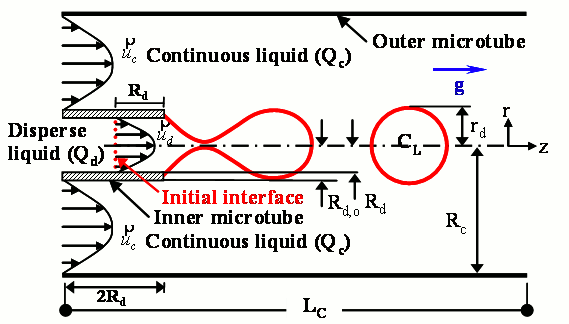
Figure 15. Schematic of a disperse droplet forming in a co-flowing immiscible liquid in a larger co-axial micro-tube.
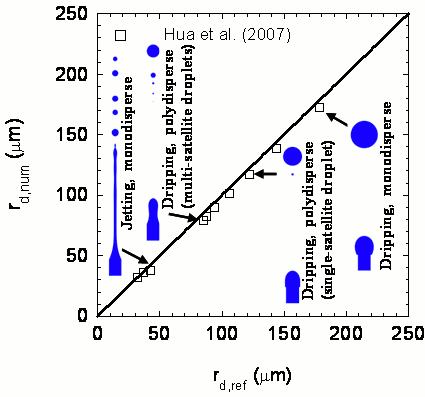
Figure 16. Comparison of present numerical calculations of radius of disperse droplets [25] with those of Hua et al. [26] for co-flowing immiscible liquids.
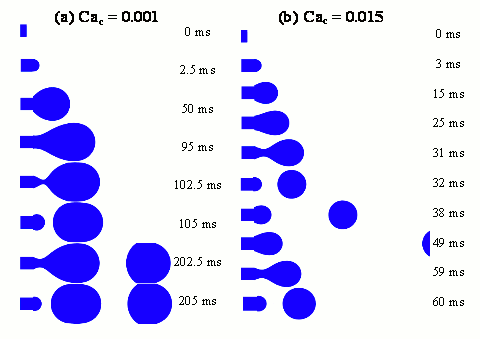
Figure 17. Images of cyclical formation of mono-disperse droplets in dripping regime at two different values of capillary number of continuous liquid, Cac [25].
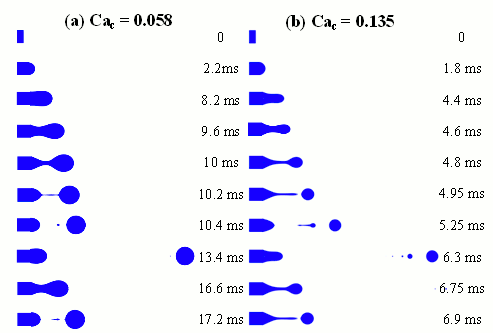
Figure 18.Successive images of the cyclical formation of poly-disperse droplets in dripping regime at two different values of Cac [25].
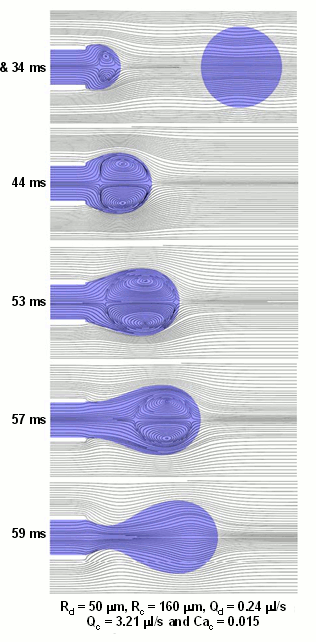
Figure 19.Flow circulation inside disperse droplet, during its stages of formation, clockwise and counter-clockwise vortices [25].
The images in Fig. 19 (to the right of the page) are of the flow fields inside a mono-disperse droplet and of the surrounding co-axial continuous liquid at different times during the formation cycle of the droplet, at Cac = 0.015 [25]. As soon as a disperse spherical pendent appears at the tip of the inner co-axial micro-tube, a pair of clockwise and counter-clockwise vortices forms inside the liquid pendent. This is shown in Fig. 19 after 4 and 34 ms into the transient or formation cycle of the disperse droplet. The extent of the internal liquid vortices increases as the droplet continues to grow, are driven by the change in the local curvature (or surface tension force) along the surface of disperse droplet.
 Back to The Top