
The ISNPS has developed, using the SIMULINK® platform, the Dynamic simulation Model (DynMo-TE) of Space Reactor Power Systems (SRPSs) that use a Sectored, Compact Reactor (SCoRe) designed for avoidance of a single point failure, and Thermo-Electric (TE) conversion (Figure 37). DynMo-TE (Figure 38) is comprised of a number of coupled physical models:
(a) The SCoRe Model couples a six-points kinetics model to a thermal-hydraulic model of the reactor core (Figure 38). The former calculates the reactor fission power, subject to the external reactivity insertion at a user specified rate and the temperature-reactivity feedback for the liquid lithium and UN fuel, and the Doppler reactivity feedback, when applicable. For long duration transient analysis DynMo-TE can account for reactivity loss due to fuel depletion.
(b) The Secondary and Primary Loop Models are coupled thermally in a PCA and a pumps' TCA (Figure 38); The coolant flow rates and pressure losses in the primary and secondary loops are calculated using the mass and momentum balance equations, at the points where the pressure loss demand-curves intersect the calculated pressure head supply-curves of the EM pumps.
(c) The Electro-Magnetic (EM) Pump Model calculates the pressure head supply-curve as functions of time and temperature, as function of the thermal and electrical resistivities of the duct wall material, coolant and copper buses, and the DC voltage and current supplied by the pumps TCA. The EM pumps use permanent magnets that are thermally insulated from the coolant ducts and maintained well below their Curie point. The magnet remains saturated by the secondary magnetic flux generated by the electric current passing through the pump ducts.
(d) The Radiator Panel Thermal-Hydraulic Model couples the 3 radiator segments (one forward and 2 in the rear) hydraulically in parallel (Figure 38), and discretizes the inlet and outlet flow channels of each segment into small axial sections. Each section comprises a small number (5 or 6) of rubidium heat pipes with C-C armor and C-C fins, and solves the coupled momentum and energy balance equations for the coolant flow rate and temperature. This model also calculates the temperature drops in the channel walls and the structure of the evaporator section of the heat pipes. The radiator model is coupled to a heat pipe model, to calculate the vapor flow and temperature drops in the heat pipes walls and C-C fins. The heat pipe model also calculates the sonic, capillary, entrainment, and incipient boiling limits.
(e) The Power Conversion Assembly (PCA) and Pumps TE Converter Assembly (TCA) Models both use a transient performance and optimization model of the SiGe unicouples. This model is also capable of predicting the performance of segmented TEs, with up to 3 different materials in each leg.
(f) Accumulator Model: To accommodate the volume changes in the liquid metal coolant in the secondary and primary loops during transient operation, each loop is equipped with a bellow type accumulator (Figure 38). The accumulator model accounts for the stiffness of the bellows, in addition to that of the compression spring. For operation redundancy, the cavity above the bellows is filled with inert gas to support the spring and the bellows in adjusting the coolant pressure in the loops. The accumulator model calculates the transient changes in the coolant volume in the accumulator, the compression length of the helical spring, and the coolant pressure in the loop.
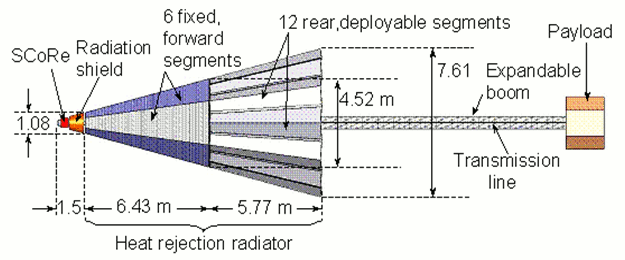
Figure 37. A layout of SCoRe-TE Space Nuclear Reactor Power System.
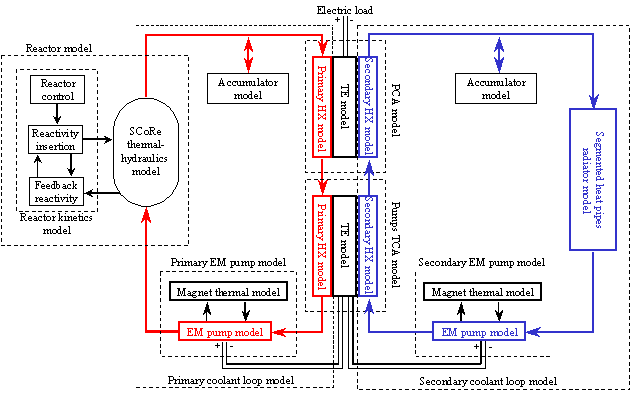
Figure 38. DynMo-TE for dynamic simulation of SCoRe-TE Space Reactor Power System (SRPS).
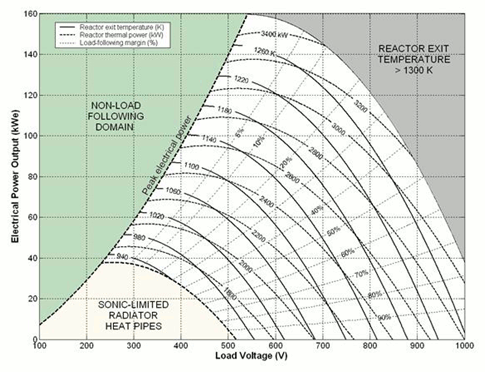
Figure 39. Steady-state operation map of SCoRe-TE, Space Reactor Power System.
DynMo-TE has been used successfully to optimize the design of the SRPS, investigate the effect of using different combinations of alkali metal coolants (Li, Na, and NaK) in the primary and secondary loops, study the startup transient and propose a startup scenario to minimize the amount of startup batteries needed, and investigate the load-following operation of the SRPS (Figure 39). DynMo-TE is particularly well suited for developing safe startup procedures and schemes for adaptive and autonomous operation and control of the SRPS.
The ISNPS is currently developing, using the SIMULINK® platform, the Dynamic simulation Model (DynMo-CBC) of Space Reactor Power Systems (SRPSs) that use a gas-cooled reactor designed for avoidance of a single point failure, and Closed Brayton Cycle (CBC) engines (Figure 40). This model shares many of the same characteristics as DynMo-TE. Figure 40 presents the layout and the nominal full-power performance parameters of a typical SRPS with 3 CBC loops. The sectored, fission reactor, cooled with He-Xe, a Pellet Bed Reactor (PeBR) or Submersion-Subcritical Safe Space (S^4) reactor, is divided into three identical sectors loaded with nuclear fuel elements. These sectors are neutronically and thermally coupled, but hydraulically decoupled. Each reactor sector provides thermal power to a CBC loop with a single-shaft radial-flow Compressor-Generator-Turbine unit, a recuperator and a gas cooler. The gas coolers in the three CBC loops heat up the molten NaK-78 in the secondary loops, which transport the waste heat to water heat pipes radiator panels. The panels, two per CBC loop, are hydraulically coupled in parallel to reduce pressure losses. The water heat pipes have carbon-carbon (C-C) fins to extend the surface area for heat rejection, and C-C armor to protect against the impact of meteoroids. The NaK-78 in the secondary loops of the radiator panels is circulated using Alternative Linear Induction Pumps (ALIPs). The operating parameters of the CBC engines presented in Figure 40 account for the mechanical losses in the bearings, the electrical losses in the alternator windings, and the electromagnetic electrical losses in the electrical generator.
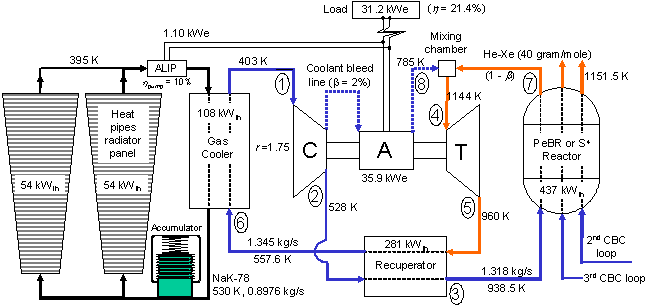
Figure 40. DynMo-CBC for dynamic simulation of multiple-loop Brayton SRPS.
The system layout in Figure 40, with a sectored nuclear reactor core, avoids single point failures both in reactor cooling and energy conversion. With a failure of one of the CBC engines, a loss-of-cooling, or a break in one of the primary gas loops, the present space nuclear power system continues to operate with two CBC engines, but at reduced electrical and reactor thermal powers. The fission power generated in the reactor sector of the failed CBC loop is transported by conduction and / or by thermal radiation to the dividers between the sectors and removed by forced convection to the circulating gas in the two adjacent sectors. DynMo-CBC will be useful for optimizing the design of the SRPS, studying the startup transient, investigating the load-following operation of the SRPS, and developing safe startup procedures and schemes for adaptive and autonomous operation and control of the SRPS.
Back to The Top