
ISNPS has developed a Dynamic simulation Model (DynMo-TE) of Space Reactor Power Systems (SRPSs) [28] with Thermo-Electric (TE) conversion, and is currently developing the DynMo-CBC [29] for simulating the dynamic behavior of SRPSs with Closed Brayton Cycle (CBC) engines (Figs. 22-24) using the SIMULINK® platform (https://www.mathworks.com/products/simulink). This platform offers an interactive graphical environment that allows rapid development of library blocks of the system components, thus components can be easily replaced or exchanged with little effort. Each component block has a number of input and output ports, and the blocks interact with each other by simply connecting these ports. Other input parameters necessary for the component blocks to operate are easily implemented through a customizable window or "mask," or by loading an input or "script" file.
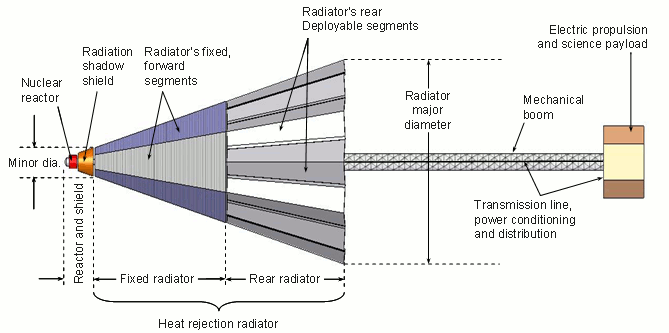
Figure 22. S4 gas cooled reactor - CBC space reactor power system, fully deployed [29]. This power system design avoids single point failures in reactor cooling and energy conversion and could generate 100 kWe for greater than 7 years [29].
Another advantage of SIMULINK® is that is does not require the development and optimization of numerical schemes to deal with steep transients and the strong couplings inherent of the physical model equations. Through its integration with MATLAB® (https://www.mathworks.com/products/matlab), SIMULINK® has immediate access to an extensive range of tools for numerical computation, time integration, algorithm development, and data visualization and analysis. In addition to significantly reducing the development time and effort, such simulation capabilities make is easy to investigate the effect of replacing different types and/or using different designs of the system components such as pumps, heat pipes, etc. on the dynamic operation of the SRPS. SIMULINK® is also particularly well suited for studying the startup of the SRPS in orbit, and associated control scenario, and for developing adaptive control strategies for use on board the autonomous spacecraft in response to: (a) changes in system parameter over the long operation lifetime, caused by fuel burnup and degradation in materials properties for example; and (b) unanticipated changes in environmental conditions, such as meteoroids impacts.
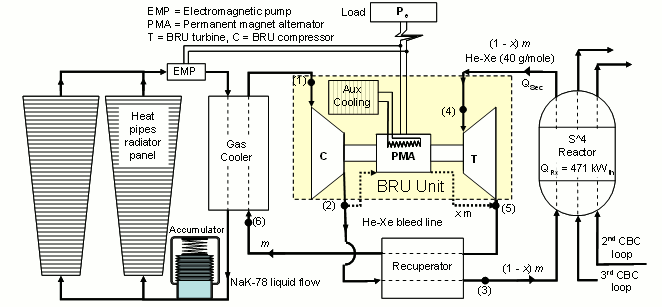
Figure 23. A layout of one CBC loop in the S4 gas cooled reactor and a closed Brayton cycle (CBC ) space reactor power system for generating 100 kWe for greater than 7 years [28].
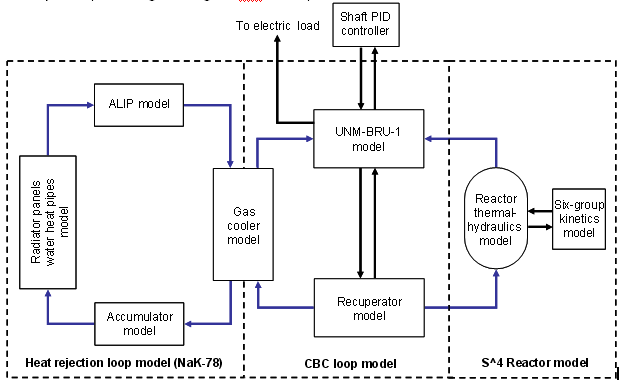
Figure 24. Building blocks of DynMo-CBC for S4-CBC space reactor power system [28].
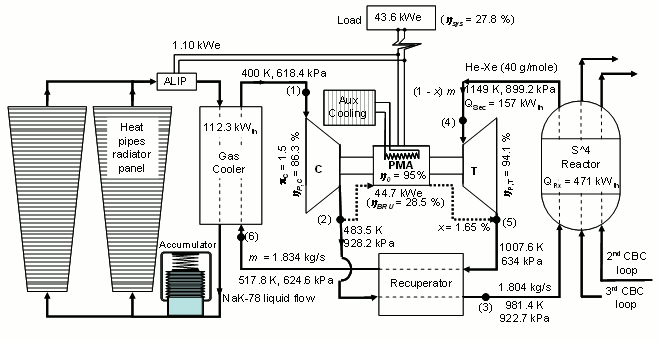
Figure 25. Full power, steady-state operation parameters in one of three loops of in the S4-CBC space power system [29].
At the system's steady-state full power operation delineated in Figure 25, each CBC loop rejects a total of 112.3 kWth to the circulating liquid NaK-78 in the heat rejection loop, to be equally rejected into space by two water heat pipe radiator panels. The corresponding specific mass of the UNM-BRU-1 is as small as ~1.16 kg/kWe and the Co-Sm permanent magnet of the BRU alternator is cooled below 500 K using an auxiliary heat pipes radiator. The bleed fraction of the He-Xe working fluid at the exit of the UNM-BRU-1 compressor, for cooling the rotating shaft, compressor and turbine disks and bearings and the electrical alternator, is 1.65% (or 30.26 g/s) (Fig. 25).
The S4 reactor's steady-state thermal power of 471 kWth is determined based on detailed thermal-hydraulic and CFD analyses, therefore increasing this thermal power requires redesigning the reactor and performing detailed
neutronics and thermal analyses. On the other hand, the power system's electrical power could be intermittently decreased below the nominal value of 130.8 kWe (Fig. 25), in order to meet
a specific power requirement profile for a space mission. This may be done in two ways:
(a) Lower the steady-state electrical power generated by the S4-CBC space power system by decreasing the thermal power of the reactor and the flow rate of the He-Xe reactor coolant
and CBC working fluid commensurate with the decrease in the reactor thermal power, while operating at the same compressor and turbine inlet temperatures of 400 K and 1149 K (Fig. 25)
and the UNM-BRU-1 (single shaft, CBC turbo-machine designed at the Institute for Space and Nuclear Power Studies [30]) at a shaft speed of 45 krpm; or
(b) Maintain the reactor's steady-state thermal power at its nominal design value 471 kWth and decrease the inlet temperature to the UNM-BRU-1 turbine to less than 1000 K,
while operating at the same compressor inlet temperature of 400 K and the UNM-BRU-1 shaft speed of 45 Krpm.
Back to The Top