
The ISNPS possesses a set of floating licenses for STAR-CCM+, which is a commercial Finite Volume Computational Fluid Dynamics (CFD) code from CD-adapco. This code package is widely prevalent throughout the industry and is one of the most comprehensive packages available. The code is capable of models ranging from 1D to 3D, and employs physical models that allow for single phase, multi-phase, and multi-component fluids, including colloidal and particle flows. In addition, fluid flow can be modeled as either laminar or turbulent (RANS, including k-epsilon and k-omega, LES and DES). These flow models can be coupled via either segregated or coupled regimes by conduction through solid elements. Modeling heat transfer by direct or correlated convection, conduction, and radiation are all possible with these coupled or segregated flows. The STAR-CCM+ code package also includes a comprehensive meshing tool capable of conformal polyhedral meshes or more traditional tetrahedral meshes, with the meshing geometry either modeled directly using the 3D-CAD package in the code or imported using a user generated Solidworks model.
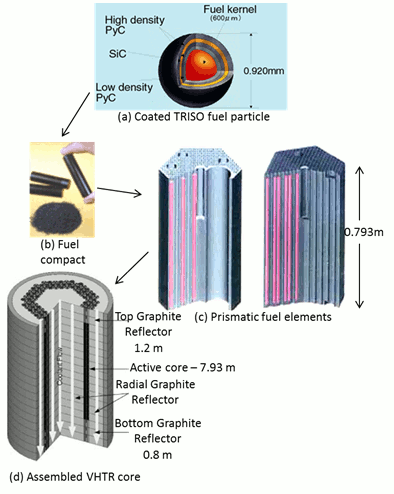
Figure 7. TRISO particle, fuel compact, and a prismatic fuel element or assembly, and cross-sectional view of an assembled Very High Temperature Reactor (VHTR).11-14
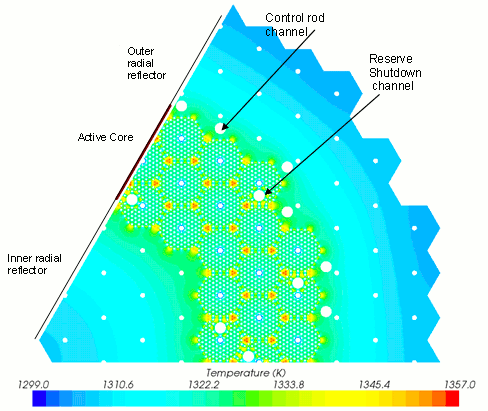
Figure 8. Calculated temperatures in a radial cross section of a full height 1/6th VHTR core during nominal operation using STAR-CCM+ Commercial Software.
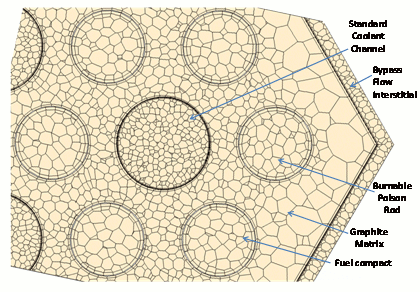
Figure 9. A close-up of the implemented numerical mesh grid in a prismatic VHTR fuel element with a helium bypass flow.
The mesher itself is a highly robust tool capable of automatically adjusting and repairing geometry based on specification from the user. STAR-CCM+ is also fully capable of parallelization for simulation runs and meshing, both on individual workstations and over a cluster (such as the one employed at the institute). The STAR-CCM+ code is also somewhat unique in that results can be accessed while the simulation is in progress without impeding or interrupting the simulation, giving the user real time feedback on the simulation. Examples include thermal-hydraulics analysis of a single fuel channel, full fuel element11 and full height 1/6th core of a prismatic Very High Temperature helium-cooled Reactors (VHTRs) (Figures 8 and 10). Figure 9 shows an example of the numerical mesh grid developed and implemented in the thermal-hydraulics analysis of a hexagonal, prismatic fuel element (Figure 6). Figurer 10 shows the numerical mesh grid developed and implemented in the thermal-hydraulics analysis of a full height 1/6 VHTR core.
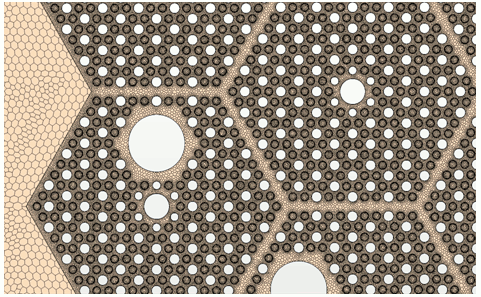
Figure 10. Numerical mesh grid implemented in the thermal-hydraulics analysis of a full height 1/6th VHTR core using STAR-CCM+ Commercial Software.
The Intitute also uses STAR-CCM+ to perform detailed 3-D thermal hydraulics analyses of space nuclear reactor concepts developed at ISNPS. The STAR-CCM+ code has been used to support multi-physics analysis of space nuclear reactors, externally coupling results with neutronics calculations performed using the Monte Carlo neutron transport code MCNPX. Detailed thermal-hydraulics calculations performed by STAR-CCM+ determine the spatial temperature profile inside the reactor core required for neutronics calculations at temperature, while MCNPX calculates the spatial thermal power profile in the fuel pins for input as a volume heat source in the thermal-hydraulics analysis. As the neutronics and thermal-hydraulics analyses depend on the results of the other, STAR-CCM+ and MCNPX are iteratively coupled together. This allows for detailed 3-D reactor analysis and design optimization. The ISNPS used this STAR-CCM+/MCNPX coupling to optimize the design of the liquid metal cooled Sectored Compact Reactor for lunar surface power (SCoRe-N) capable of supplying 40 kWe to a crewed outpost for more than 20 years (Figure 11). The core of the SCoRe-N is divided into six hydraulically independent sectors to avoid a single point failure in case one of the six sectors suffers a loss of the liquid NaK-78 coolant. Figure 12a shows a section view of one of the six core sectors in the SCoRe-N5 reactor operating at its full nominal power of 1 MWth. STAR-CCM+ is also used to model heat removal from a core sector in case of a loss of coolant, simulating conduction and radiation heat transfer within the sector voided of liquid NaK-78 coolant to the adjacent functioning sectors (Figure 12b).
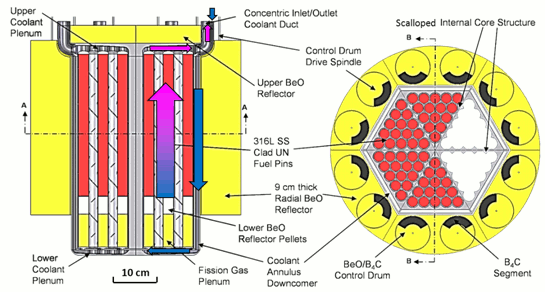
Figure 11. Cross-sectional views of the SCoRe-N5 design with coolant flow path detailed in section B-B.
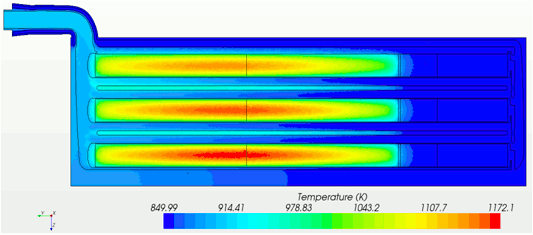
Figure 12a. Calculated temperatures at symmetry plane in SCoRe-N5 reactor with cusped cladding at 1 MWth.
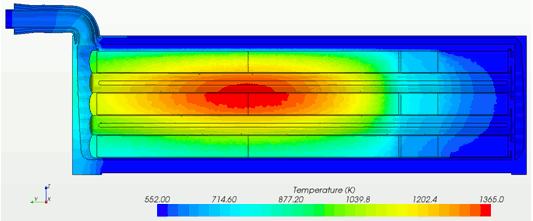
Figure 12b. Calculated temperatures at the symmetry plane in the sector with cusped cladding experiencing a loss of coolant at 166.6 kWth.
Back to The Top